Mobile app · Android · iPhone

NMR Solvent Impurities
What is that unknown peak in your spectrum? Enter the solvent, chemical shift and splitting, and search the residual peaks of deuterated solvents and common trace impurities instantly.
A free, fully offline reference app for NMR users. The data were compiled from the peer-reviewed literature, and the source of every value is shown in the app.
Free · No ads · Offline · Version 1.0
- 86
- common impurities
- 20
- deuterated solvents
- 3000+
- ¹H and ¹³C values
- 75
- CHEM21 solvents
What it does
Everything you need to identify peaks from solvents or trace impurities in an NMR spectrum, in one app.
Peak search
Choose the solvent, the chemical shift (± tolerance) and the splitting. Exact matches come first, compatible splittings next; incompatible ones are left out.
Multiple peaks
Enter several peaks with their splittings or paste a list. Impurities are ranked by the number of matching signals, closeness and splitting agreement.
Solvents
Residual ¹H/¹³C peaks, J(H,D) values, water/HOD peak, physical properties and storage conditions of 20 deuterated solvents. A temperature-dependent HDO calculator for D₂O.
Impurities
More than 3000 values for 86 common impurities in 12 solvents. Search by English or Turkish name, abbreviation (EtOAc, DCM…) or formula.
CHEM21 green chemistry
Safety, health and environment scores of 75 solvents, their ranking from “recommended” to “highly hazardous”, and how the scores are obtained.
Records
Save results with a sample name, analysis date and note, and mark the impurities you identified. Records stay on your device.
How it works
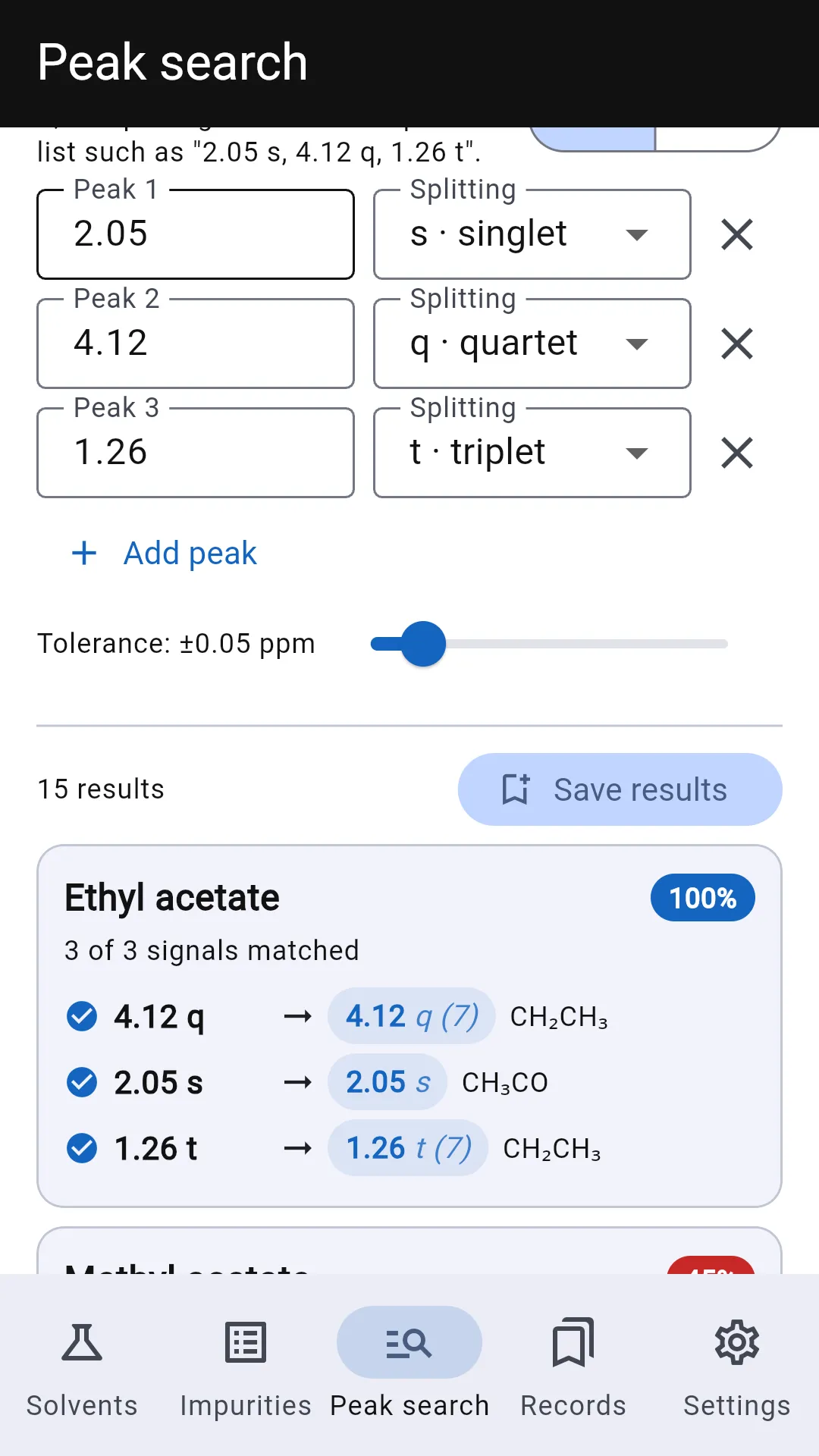
An example: a crude product in CDCl₃ shows unexpected peaks at 2.05, 4.12 and 1.26 ppm.
- Step 1
Describe your peak
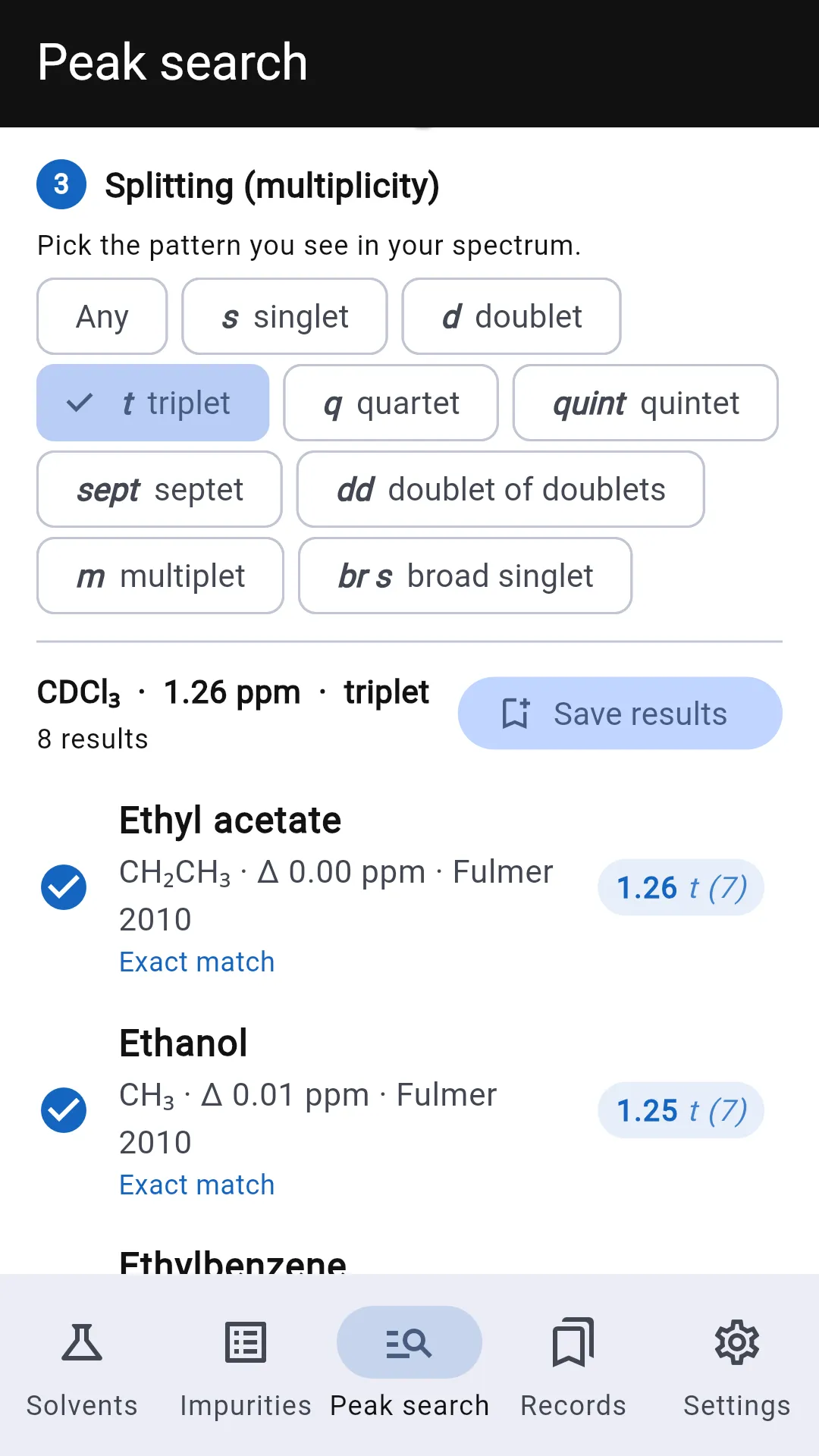
In the Peak search tab, choose the solvent, type the chemical shift and tick the splitting you see — for example a triplet at 1.26 ppm in CDCl₃. The candidates appear instantly: ethyl acetate, ethanol and others, each with its source.
- Step 2
Search several peaks together
In multiple-peak mode, enter each peak with its splitting on its own row, or paste a list such as “2.05 s; 4.12 q; 1.26 t”. The app matches the peaks to the impurities' signals; here ethyl acetate matches all three signals (100%).
- Step 3
Check the details and the source
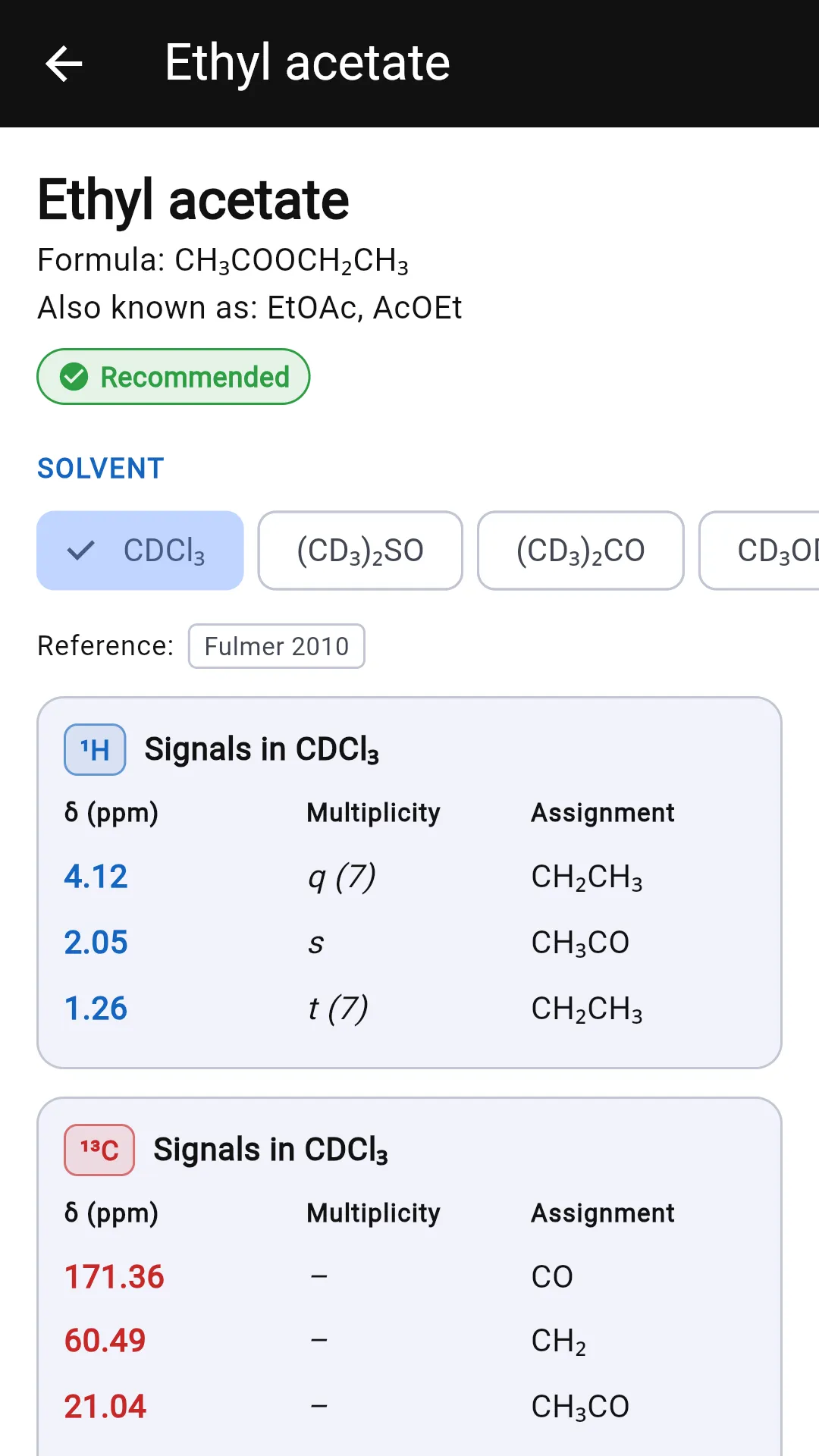
Tap a candidate to see its ¹H and ¹³C values in every solvent, multiplicities and J values, assignments and CHEM21 assessment — with the publication each value comes from.
- Step 4
Save the result
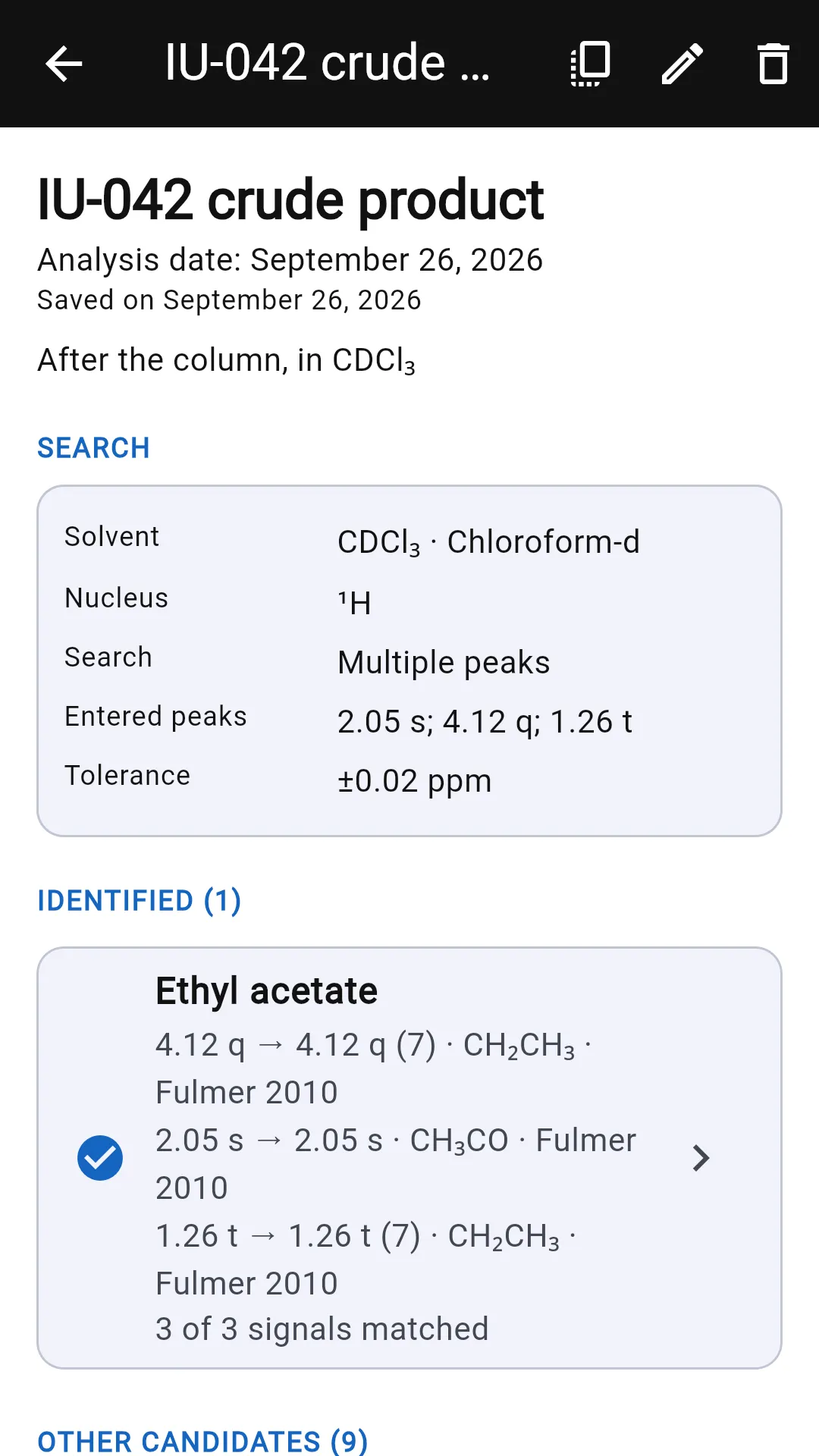
Use “Save results” to add the sample name, analysis date and a note, and mark the impurities you identified. Come back from the Records tab any time, or copy the record as text into your report.
More screens
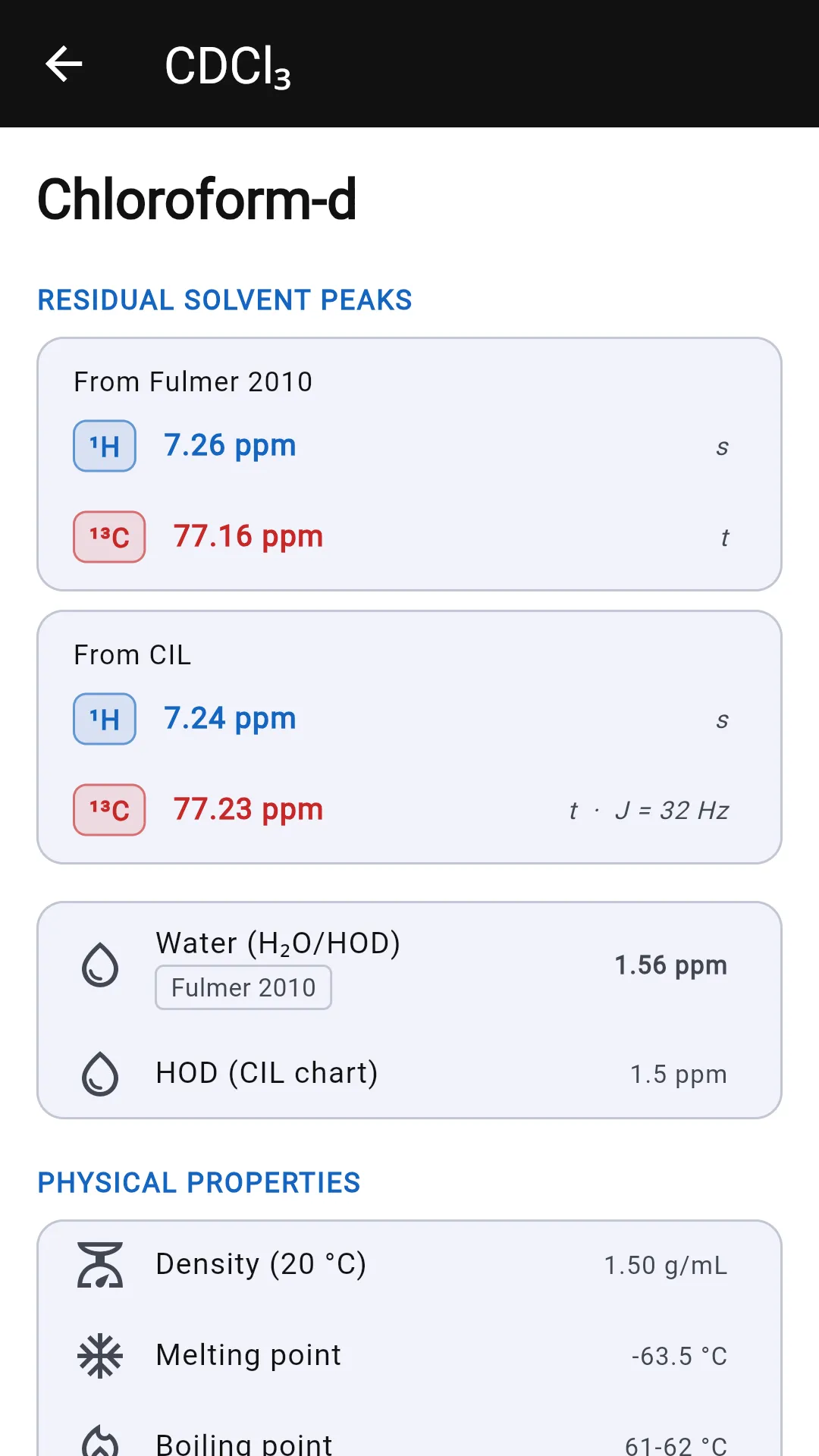
Solvent details: residual peaks and physical properties 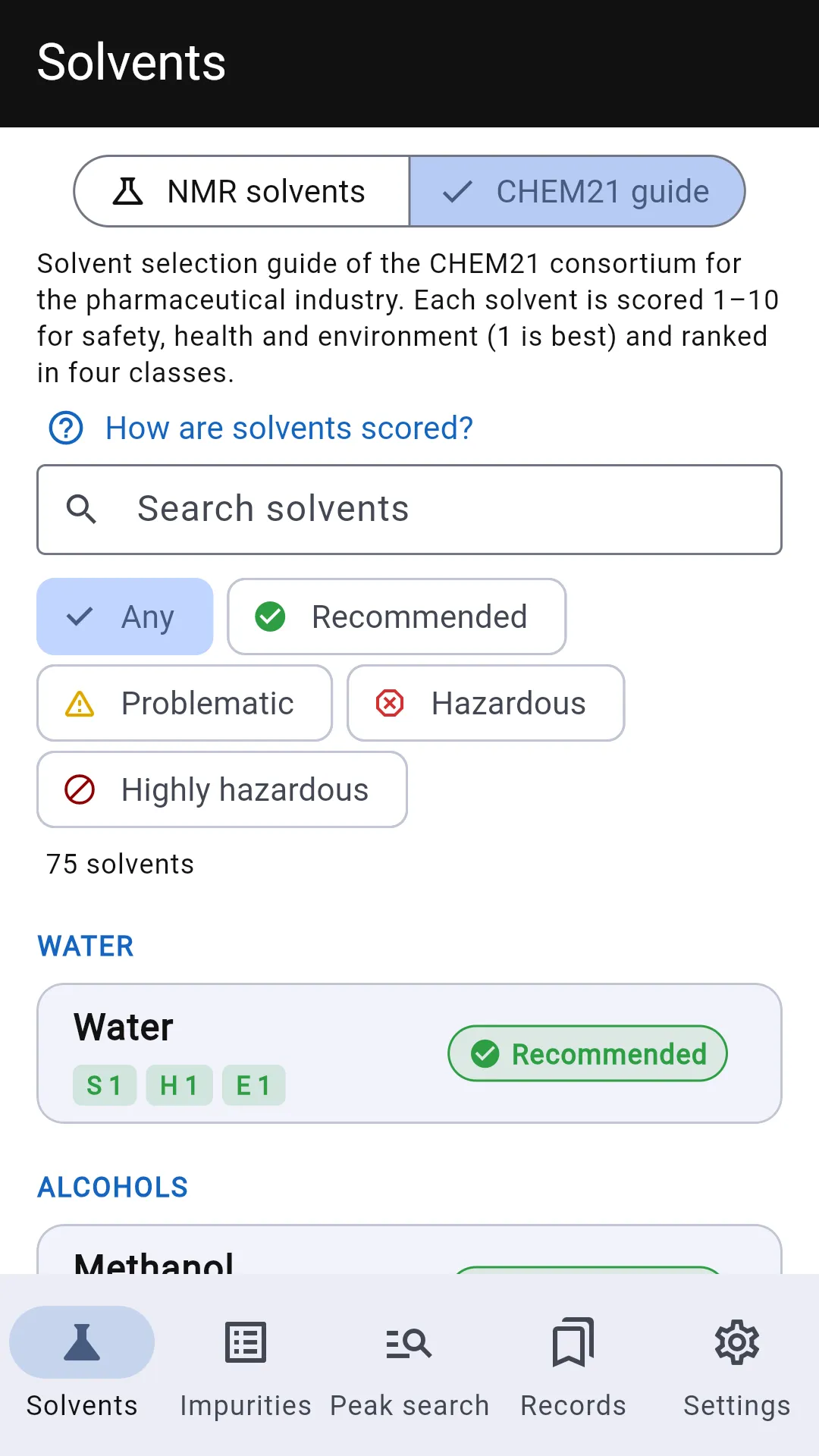
CHEM21 green chemistry guide 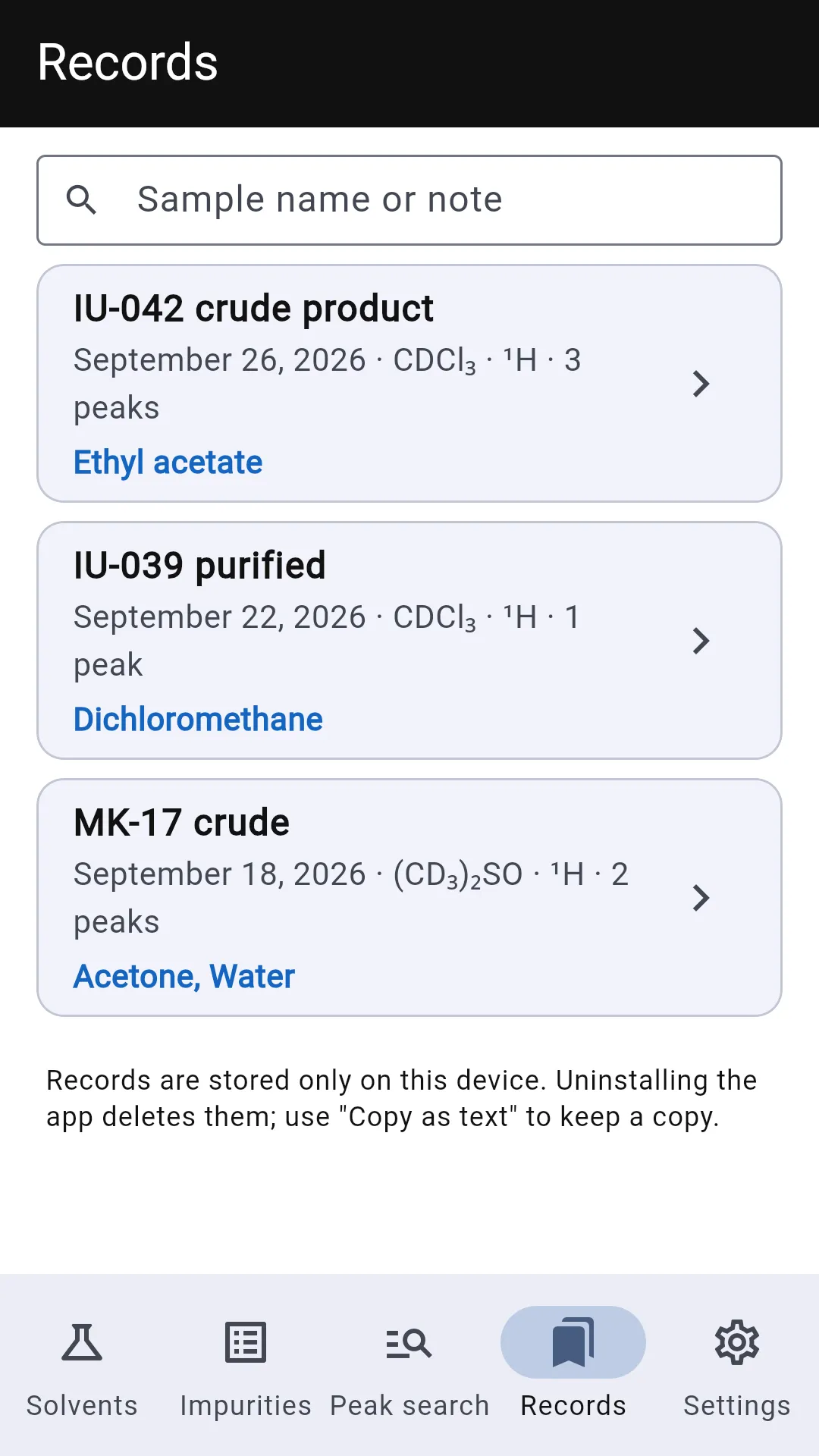
Records, sorted by analysis date
Where do the data come from?
The values were transcribed from the tables of these publications and checked against the printed tables. Where a compound appears in more than one source, Fulmer 2010 takes precedence over Gottlieb 1997 and Babij 2016. Chemical shifts can vary with concentration, temperature and pH; consult the original sources and your own measurements for a definitive assignment. The app is not affiliated with the publishers or with Cambridge Isotope Laboratories.
- H. E. Gottlieb, V. Kotlyar, A. Nudelman, J. Org. Chem. 1997, 62, 7512–7515.doi:10.1021/jo971176v
- G. R. Fulmer, A. J. M. Miller, N. H. Sherden, H. E. Gottlieb, A. Nudelman, B. M. Stoltz, J. E. Bercaw, K. I. Goldberg, Organometallics 2010, 29, 2176–2179.doi:10.1021/om100106e
- N. R. Babij et al., Org. Process Res. Dev. 2016, 20, 661–667.doi:10.1021/acs.oprd.5b00417
- D. Prat et al., Green Chem. 2016, 18, 288–296 (CHEM21).doi:10.1039/c5gc01008j
- Cambridge Isotope Laboratories, Inc., NMR Solvent Data Chart.
Trustworthy, open and private
No data collected
No account, ads, analytics or internet connection. Your records and settings stay on your device.
Open source
The source code and data tools are on GitHub under the GNU GPL-3.0 license, so anyone can check how each value was transcribed.
Turkish and English
The interface is bilingual and search ignores Turkish accents. Six colour themes, light and dark mode.
Frequently asked questions
Does the app cost anything?
No. The app is free, with no ads and no in-app purchases.
Does it need an internet connection?
No. All data ship with the app, so you can use it offline in the lab.
Where are my records stored?
Only on your device. They are removed if the app is uninstalled, so copy important records into your report or notebook with “Copy as text”.
Which solvents are covered?
Impurity tables cover CDCl₃, DMSO-d₆, acetone-d₆, CD₃OD, D₂O, C₆D₆, CD₃CN, CD₂Cl₂, THF-d₈, toluene-d₈, C₆D₅Cl and TFE-d₃. Residual peaks and physical properties are given for 20 deuterated solvents in total.
What if a value is wrong?
Please open an issue on GitHub or send an email; the value will be checked against the original table and corrected.
Which devices does it run on?
Android phones and iPhone. The app is available on the App Store and will soon be available on Google Play.
Support
For questions, suggestions and bug reports, send an email or open an issue on GitHub.